“Never Forget”: Captain Jay Fujita and the Lessons of Lahaina
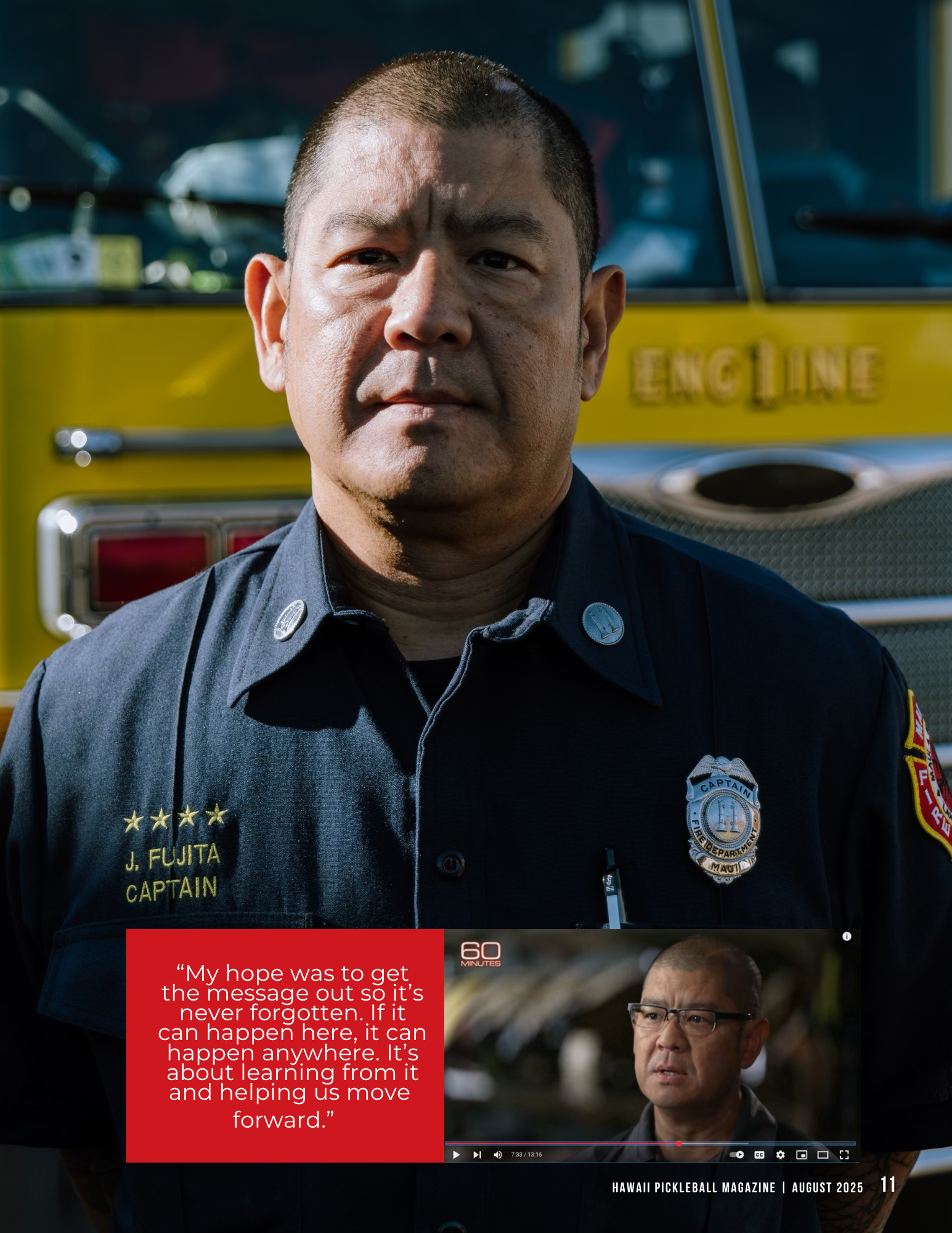
Fire Captain Jay Fujita didn’t plan to become the face of Maui’s wildfire response. He’s not someone who seeks the spotlight. He’d rather be behind the scenes, taking care of his crew and doing the work. But when 60 Minutes came calling, he stepped up…not for attention, but for Maui.
Jay was born in California but raised in Maui from age six. A former schoolteacher, he’s been with the fire department since 1999 and now leads Engine 1 out of Wailuku Station. What still stays with him from that day in August 2023 is a humbling realization: “This was one of the few times in my career that we didn’t win.”
Jay and his crew pushed into the fire with courage, fully aware that their own brothers in the department were losing homes at that very moment. “Some of those homes had been in families for generations. They were fighting to save other people’s homes while their own were burning down,” he said.
He remembers racing into neighborhoods engulfed in smoke, the air so thick you could barely breathe. “The fire moved faster than anything I’ve ever seen,” Jay said. "You’d put water down, and the wind would whip the flames right past you. It was like chasing a ghost."
In an interview with 60 Minutes, Jay recalled being trapped and sheltering in place. He texted his wife, telling her he loved her and asking her to pass the message on to his family—“because there was a good chance we might not make it out.” But it was too hot inside the fire truck, and the message never went through.
Looking back, Jay reflects on how the experience shaped him. “I think through my whole career, there was maybe only one other time we didn’t win,” he says. “Usually we win in these fights against the fires. This was the one time we were totally outnumbered, trampled. It keeps you humble—knowing there are things we can’t overcome. You just do the best you can. That’s always been my mentality. We take care of it and win. But this one gave me a different perspective.”
When asked how his outlook has changed, Jay is thoughtful. “At the time, there was a good possibility we wouldn’t make it out. So yeah, you try not to take things lightly or for granted.” Still, he says, it didn’t change his personality. “I think I’m pretty much the same. It just opened our eyes more to the reality of what can happen.”
He continues: “I just hope and believe that our department will be better from it. Because we had to deal with and live through that, we’ve prepared for a lot—and there’s very little that can be more than that.
Pickleball, for him, is less therapy and more release. Introduced to the game at the fire station just before COVID, he and his crew used it as a way to stay active, connect, and blow off steam. “I’ve never really thought of it as a form of recovery,” he says, “but when I’m playing, my mind’s off everything else. I guess it does help.”
Pickleball quickly became a station-wide staple— replacing the basketball, volleyball, and other sports they used to play. Jay sometimes plays as often as five times a week at the courts just two minutes away from his station—schedule and wind permitting. He prefers the finesse of the kitchen game over baseline power and plays with the JOOLA Gen 3.
When asked what he enjoys most about the game, Jay points to its accessibility: “You can play on your first day. You can’t do that with tennis.”
Jay carries a deep sense of responsibility to Maui. When asked to do media, he steps out of his comfort zone—not because he enjoys the spotlight, but because he believes it’s important to keep the memory alive and ensure continued support for those affected.
“I had the opportunity to bring awareness,” he says.
That deep sense of service—to protect and honor the stories of others—is rooted in a lifetime of public safety. And that’s what keeps him speaking up. For Jay, it’s not about reliving the past. It’s about making sure it’s never forgotten.